
Gestures Across the Silence
The Art of Racing in the RainThis thread follows Enzo's effort to communicate love and judgment without human speech, showing how his gestures, attention, and presence become forms of moral participation.
increasing Bearing strength in each event
 decreasing
Bearing strength in each eventdecreasingThe Body as a Message
The Body as a Message
A deliberate performance
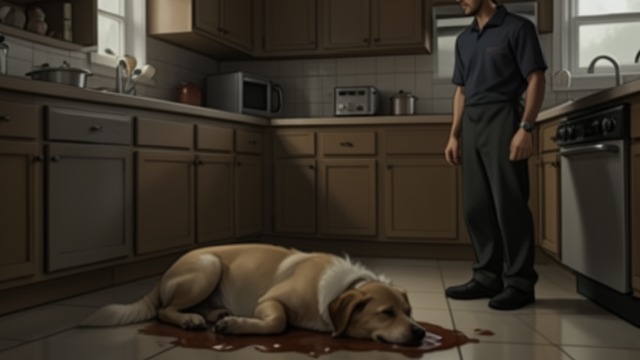
Old and ill, Enzo lies on the kitchen floor in his own urine, hoping Denny will understand that he is ready to die. He intends the scene as a message of love: Denny has survived years of grief and struggle, and Enzo wants to release him from the burden of caring for an aging dog. But the performance becomes real when Enzo discovers that he truly cannot stand.
Expression without words
Enzo's body is his most reliable instrument. He can wag, withdraw, lean against a leg, or resist getting up, but he cannot explain the intention behind those actions. Denny interprets the scene through his own worry and guilt, believing his lateness may have caused the accident.
The opening establishes the central cost of Enzo's silence: even an affectionate gesture can be misread. His intelligence does not give him access to human language, so communication depends on patience and shared history. The story repeatedly asks whether those who cannot speak are nevertheless understood by those who love them.
The Promise to Protect
The Promise to Protect
Eve's private appeal
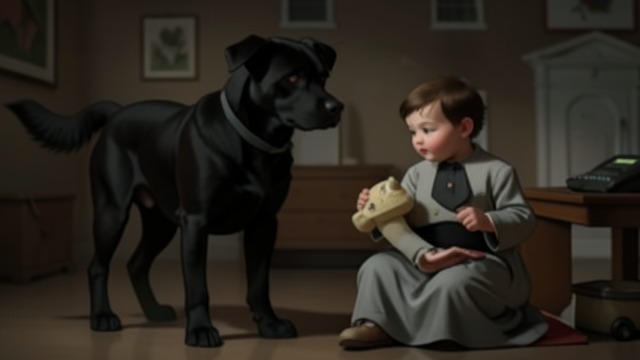
After Zoë's birth, Eve asks Enzo whether he will always protect the baby. Enzo knows Eve is speaking to Denny through him, yet he accepts the obligation as his own. The moment changes his sense of purpose: although he cannot participate in human life as fully as he wants, he can provide something the family needs.
A role beyond speech
Enzo cannot make a verbal promise, but his presence and later behavior become its answer. He watches over Zoë, joins her games, and adjusts his conduct so Eve will not worry about him hurting the child. Protection is not a single dramatic rescue; it is a continuing practice of attention and restraint.
The promise also establishes a standard Enzo uses to judge himself. When Zoë's toys are destroyed and he cannot make anyone believe his account of the zebra, he feels he has failed her. His silence limits what he can defend, but the promise gives his actions a meaning that persists beyond his ability to explain them.
Listening as Participation
Listening as Participation
A witness without a voice
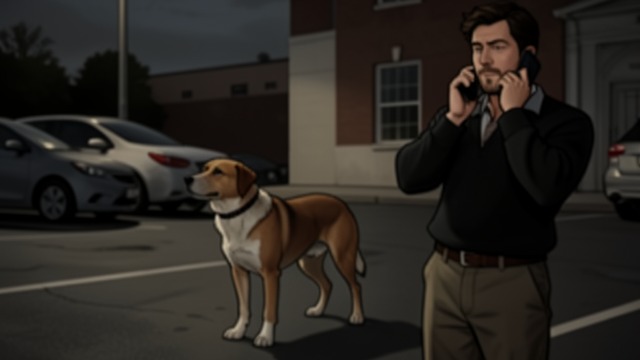
At the hospital, Enzo cannot enter with Denny and is not included in the medical conversations about Eve. He listens from the parking lot as Denny explains the mass in her brain and admits how frightened he is. Because Enzo cannot interrupt, redirect, or make the moment about himself, he attends closely to what Denny actually says.
The limits of understanding
Enzo regards listening as a human virtue and imagines how people often seize another person's story to tell their own. His silence gives him an unusual kind of attentiveness, but it does not make him omniscient: he misreads motives and sometimes mistakes his own interpretation for fact. Listening can offer companionship without guaranteeing perfect knowledge.
The scene makes Enzo a witness to Denny's fear when few others can reach him. He cannot solve the medical crisis or give advice, yet his steady presence has value. The novel treats attention itself as a form of care, especially when a person cannot change the facts but can refuse to leave another person alone with them.
A Gesture Against Surrender
A Gesture Against Surrender
A refusal Denny can see
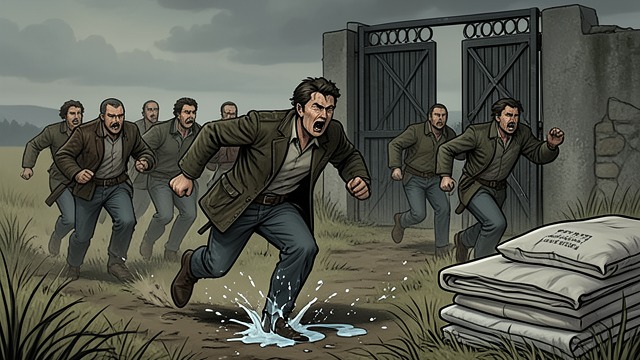
Enzo cannot tell Denny that the proposed custody agreement would violate his deepest wish to remain Zoë's father. Instead, he takes the papers in his mouth, escapes the men pursuing him, and finally urinates on the document. His action is unruly and unmistakable, a message delivered in the only language available to him.
Laughter as recognition
At first Denny is angry, but the absurdity of the act breaks the tension and makes him laugh with Mike. The laughter does more than relieve the room: it reconnects Denny with himself after despair has reduced his world to debt, legal threats, and failure. He decides that he will not sign away the fight.
The scene shows that a gesture need not be elegant to be meaningful. Enzo cannot formulate an argument, yet his refusal makes Denny confront the choice he is about to make. The papers are reprinted later, but the interruption has already restored Denny's sense that the decision remains his.
The Farewell Signal
The Farewell Signal
A familiar touch
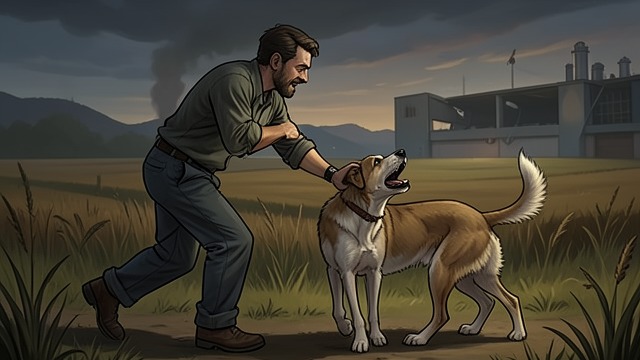
As Enzo's body fails, Denny reaches down to scratch the familiar crease behind his ears. Their relationship has been carried through repeated physical gestures: a hand on Enzo's head, a muzzle pressed to Denny's leg, a tail wag in reply. At the end, this small touch communicates more than either needs to say aloud.
The last two barks
Denny tells Enzo he may go, and Enzo imagines running into the fields where he was born. As he leaves, he barks twice, the signal he once used to request more speed on the track. The bark carries their shared history into the moment of separation: it means movement, joy, and one more lap together.
Enzo cannot make Denny hear a sentence about what he has meant, but he trusts that the familiar signal will be recognized. His final communication is both a farewell and an affirmation of their bond. The story closes with an action rather than an explanation, completing its argument that love can be legible even when language is unavailable.
At the opening when Enzo pretends he cannot rise
Immediately after Zoë is born while Denny is away at Daytona
During the night Denny waits outside the hospital after Eve's fall
At Mike's house when Denny is about to sign the settlement
In Enzo's final moments with Denny
